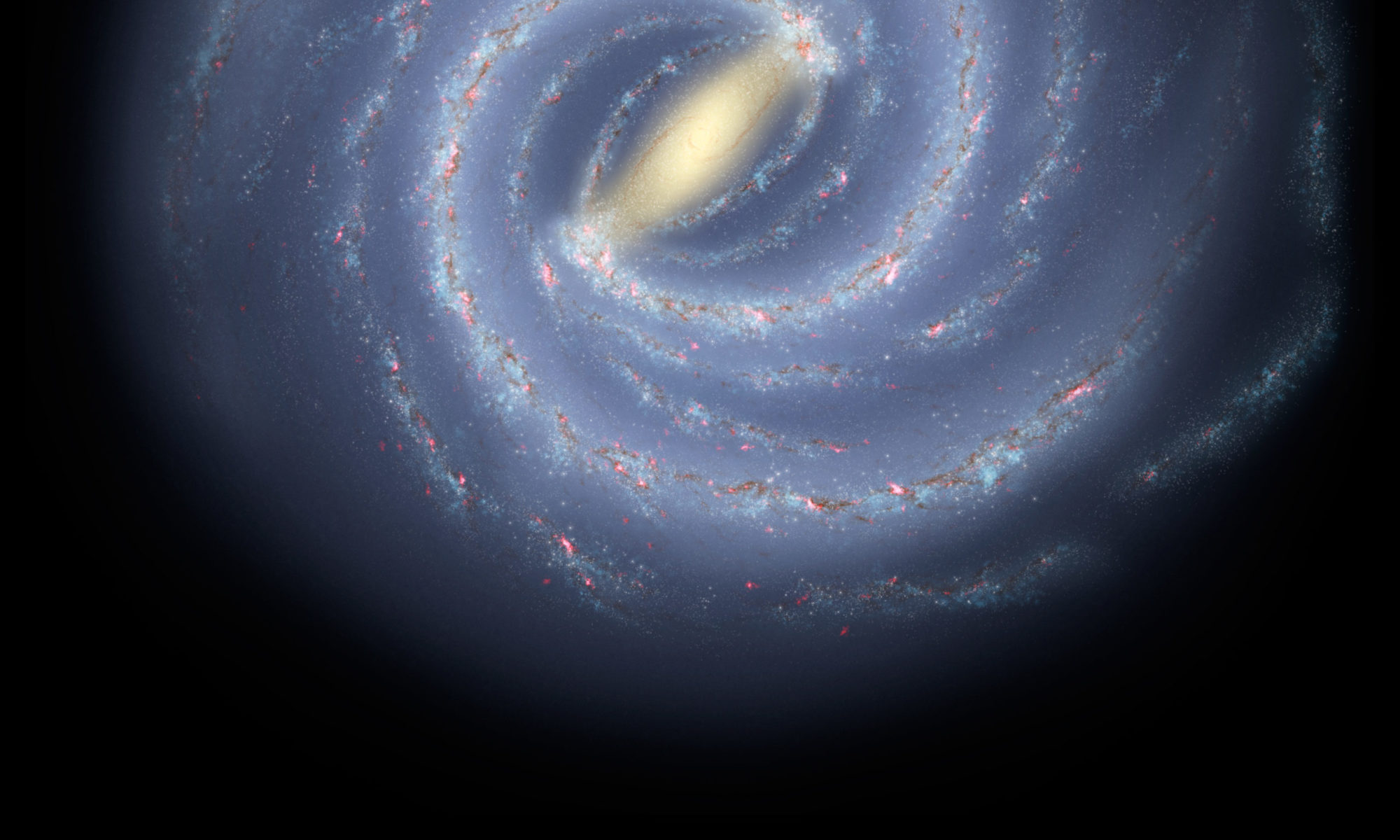
The processes that drive the formation of giant molecular clouds (GMCs), their evolution and star formation are thought to occur primarily in spiral arms. To understand our own Galaxy’s star formation, the broader perspective offered by nearby galaxies with different global spiral structure is very valuable. Expansion of (sub)millimetre capabilities to high angular resolution offered with interferometers allows to resolve GMCs in nearby galaxies. Over the next decade, observations with even higher angular resolution and sensitivity will enable sampling of smaller scales at larger distances. This enables us to place the Milky Way in the context of other galaxies. The goal of the PERSEUS project was to produce the first map of the Milky Way’s Perseus spiral arm in the Outer Galaxy from the perspective of an external observer with the same spatial resolution along the whole spiral arm. From this map a uniform GMC sample can be extracted to derive their physical conditions including their star-forming content. These spiral arm data cubes and the distance-calibrated cloud catalogue will be extremely valuable for future comparison with Galactic and extragalactic GMCs
Objectives
The main goal of the project is to produce the first map of the Perseus spiral arm in our outer Galaxy as would be seen by an external observer at fixed spatial resolution. The Perseus arm extends over one third of the Milky Way’s observed span and covers different environmental conditions. 12CO data of the spiral arm are convolved to the same spatial resolution and regridded onto maps of constant linear scale.
A fundamental benchmark sample of GMCs is extracted from these Perseus spiral arm maps using a cloud-finding algorithm to determine their physical conditions and for comparison with GMCs in the inner Galaxy. This allows us to study the impact of different kinds of environments.
The first common resolution map of the Perseus arm is reprojected to any desired spatial resolution, to match observations of nearby galaxies and to provide a tool for comparison with extragalactic surveys.

This project has received funding from the European Union’s Horizon 2020 research and innovation programme under the Marie Skłodowska-Curie grant agreement No 796461.
Exeter University
The University of Exeter is a research-led university, and is a member of the UKs Russell Group of leading research intensive universities. The PERSEUS project is hosted within the Astrophysics Group at the University of Exeter, which has built a strong international reputation, particularly in the areas of exoplanets and star and planet formation.
Contact
Dr. Marion Wienen
University of Exeter, Astrophysics Group
Stocker Road, Exeter, EX4 4QL, UK
E-Mail: m.wienen@exeter.ac.uk
This project has received funding from the European Union’s Horizon 2020 research and innovation programme under the Marie Skłodowska-Curie grant agreement No 796461.